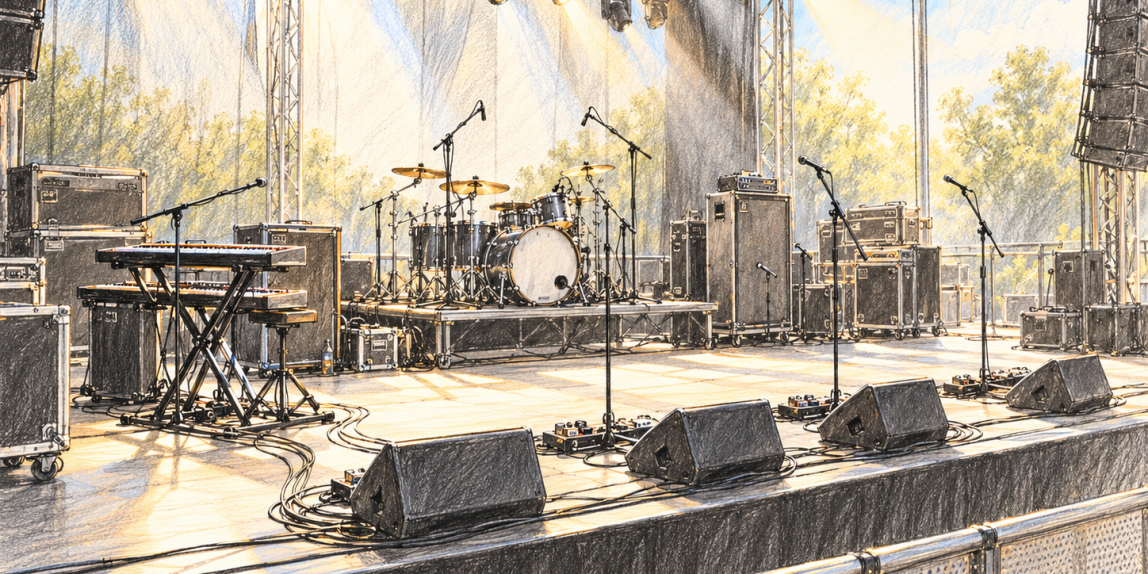
A stage plot should answer the questions everybody wishes somebody had answered before soundcheck.
Where does the drummer go? Which side is the keyboard rig on? Who needs a vocal mic? How many DIs? Who is on in-ears? Where does the sax mic land? Is that guitar amp actually onstage, or did somebody just assume it would be?
If your production team has to play detective while the band is standing around waiting, the stage plot failed.
And the input list is its partner. One shows where everything lives. The other shows what the audio team actually has to connect.
A good stage plot is not fancy. It is useful enough that somebody who has never met your band can build the stage correctly.
First, know the difference between the stage plot and the input list
I see these two things mashed together all the time, which is how you end up with a beautiful PDF that somehow still does not tell the engineer how many channels you need.
Stage plot
A visual map of the stage: musician positions, instruments, amps, keyboard rigs, drum kit, vocal positions, monitors, DIs, power needs and major equipment locations.
Input list
A channel-by-channel list of everything feeding the console: kick, snare, bass DI, keys left/right, guitar mic, tracks, vocals, horns, playback, talkback and whatever else actually needs an input.
You usually want both.
The plot helps the crew build the room. The input list helps the audio team wire it.
Your plot should match the show you are actually bringing
This sounds painfully obvious until somebody sends a rider from three tours ago.
Now the plot says five musicians, the contract says four, the keyboard player has moved to the other side of the stage, there is no percussionist anymore, and somehow a conga setup is still living in the PDF like a ghost.
Production documents should be current.
If the band changes, update them. If the playback rig changes, update them. If somebody moved to in-ears, update them.
The stage crew is not supposed to reverse-engineer your history.
Show people where the bodies and the big objects go
You do not need architectural drawings.
You need clarity.
Put the drummer where the drummer goes. Put keys stage left or stage right. Put guitar amp locations where they actually belong. Mark the lead position. Mark background vocals. Show any playback station, laptop rig, percussion setup, horn position, risers, or unusual equipment.
A simple five-piece stage map
Vocal mic
Monitor / IEM
Riser if supplied
Monitor / IEM
Vocal mic
Monitor / IEM
Horn mic
Monitor / IEM
Amp if used
Monitor / IEM
Power
Operator position
That simple map can save more time than a paragraph explaining where everybody likes to stand.
Mark the things that cause stupid surprises
The obvious equipment is usually not what creates the problem.
It is the small stuff.
The keyboard needs two DIs, not one. The playback rig needs stereo outputs. The guitarist is using a modeler and does not need the amp somebody rented. The horn player needs a clip mic. Somebody needs a tall boom. Somebody else needs power in a place nobody expected.
Those details are exactly why this document exists.
My rule: if forgetting an item would force somebody to scramble during load-in or soundcheck, put it on the plot, input list, or advance email.
Build the input list like the engineer is meeting you for the first time
Because sometimes they are.
A clean input list should make channel assignment easy.
Something like:
- Kick
- Snare
- Hi-hat
- Rack tom
- Floor tom
- Overhead left
- Overhead right
- Bass DI
- Guitar
- Keys left
- Keys right
- Playback left
- Playback right
- Lead vocal
- Background vocal 1
- Background vocal 2
- Horn
Then add notes where they matter: phantom power, DI required, mic preference, stand type, submix, stereo pair, wireless system, or anything unusual.
You do not need to micromanage the house engineer’s entire life. Just give them the information required to understand your setup.
Do not turn preferences into fake requirements
This is another place artists can make themselves harder to work with than necessary.
If something is truly required, say required.
If something is preferred, say preferred.
Those are different words for a reason.
If your entire performance collapses without one exact microphone model, fine—make that clear and deal with the consequences when a venue cannot provide it.
But if three comparable options would work, do not make the local production team feel like civilization ends if they bring the wrong brand.
Specificity is useful.
Drama is not.
Put monitors and in-ears on the plot too
Do not make the monitor engineer guess who needs what kind of monitoring.
If the drummer is on ears, say it. If the keyboard player wants a wedge, say it. If the lead uses a wireless in-ear system, note it.
You do not need the entire monitor mix written on the stage plot. That conversation can happen during the advance or soundcheck.
But the physical monitoring setup should not be a surprise.
Your playback rig deserves grown-up documentation
Tracks are where things can get real stupid real fast.
How many outputs? Stereo or stems? Who starts playback? Is there a click? Does the drummer receive it? Is there timecode? Does the rig need house DIs? Does it need a power drop? Is the computer staying onstage?
If your show depends on playback, treat that rig like an instrument.
Do not show up with a laptop and a look of optimism.
Advance the current documents—not just the attachment
Emailing the stage plot does not mean anybody actually looked at it.
During the advance, confirm that production received the current plot and input list and ask whether anything cannot be supplied as requested.
That is especially important on fly dates, festivals, shared bills, and venues where backline is local. I go deeper into that in what musicians should know before taking a fly date.
Your EPK can also point promoters toward the right production materials. My guide to what should be on a musician’s website covers the broader booking package.
Make it readable on a phone
A surprising amount of production communication gets opened while somebody is standing on a stage, walking through an airport, loading a truck, or trying to solve something with one hand.
Do not build a stage plot that requires a 32-inch monitor and forensic zoom.
Use large labels. Clear positions. Minimal clutter. One page if you can. Put the act name and current date/version on it.
And please do not make every cable path a different decorative arrow until the thing looks like air traffic control.
Do one final reality check before you send it
Look at the stage plot and ask:
- Is this the band actually traveling?
- Are the musician positions correct?
- Are all vocal mics shown?
- Are stereo instruments clearly stereo?
- Are DIs and unusual inputs identified?
- Are monitor/IEM needs clear?
- Are playback requirements documented?
- Does the input list match the picture?
- Would a local crew understand this without calling me six times?
If the answer to that last one is yes, you are doing your job.
The whole point is to protect soundcheck
I do not care about having the world’s prettiest stage plot.
I care about walking into the venue and seeing the bones of the show already sitting where they are supposed to be.
That gives the band more time to play.
It gives the engineer more time to actually listen.
It gives everybody more room to solve the problems that could not have been predicted instead of wasting twenty minutes on problems that absolutely could have been.
That is what good production paperwork does.
It turns “Wait, where does this go?” into “Cool. Let’s soundcheck.”
About Jackiem Joyner: Jackiem Joyner is a touring recording artist, bandleader, producer and working musician. His road and production writing focuses on the practical systems that make live shows smoother before the first note is played.