
Working artist / Touring operations
A fly date can look simple on paper: get on a plane, play the show, come home. Cute. In real life, the gig starts long before downbeat.
A fly date is basically a show where you travel by air and the larger gear is waiting on the other end. Sounds efficient. Sometimes it is. Sometimes one missing keyboard pedal, one stupidly tight connection, or one vague sentence like “yeah, we’ve got backline” can turn your day into a circus.
I look at fly dates from both sides because I tour as an artist and I lead bands. The musician needs enough information to do the job without guessing. The person leading the show needs everybody to show up prepared, on time, and not texting from baggage claim asking where soundcheck is.
That means a fly date is not just a plane ticket. It is a chain of small decisions. If too many of those decisions are sloppy, the music pays for it.
The before-you-say-yes checklist
- Money: fee, covered expenses, payment timing, and who eats the cost if travel changes.
- Travel: actual airports, actual flights, baggage allowance, and enough margin before the venue call.
- Instrument: case dimensions, cabin plan, and what happens if somebody suddenly decides your instrument belongs under the plane.
- Backline: exact gear, accessories, substitutions, and the name of a human being who actually confirmed it.
- Ground and hotel: pickup contact, vehicle size, room confirmation, and whether you can actually get into that room before soundcheck.
- Show: rehearsal, soundcheck, stage time, set length, music, and dress.
- Recovery: who gets the first call when travel starts falling apart.
Get the deal clear before you buy anything
“Travel is covered” is one of those phrases that can mean absolutely everything and absolutely nothing.
Covered by who? Which airport? Which fare? Is baggage included? Can the ticket change? Are you expected to pay first and chase reimbursement later? Is the hotel separate? Ground transportation? Per diem?
Get it clear before the card gets charged.
And separate the performance fee from the cost of getting there. A number can look pretty decent until you realize you just donated a hotel night, two airport rides, instrument baggage, and half your weekend to make it happen.
That last part matters too. A Saturday gig can own Friday through Sunday. The show may be ninety minutes. Your life does not experience it as ninety minutes.
Also ask what happens when something breaks: canceled show, canceled flight, missed connection, extra hotel night. You do not need a 14-page disaster treaty. You just need the grown-up version of, “If this goes sideways, who makes the call and who pays for what?”
Advance the show with somebody who can actually answer you
Advancing is where the fantasy version of the gig meets the real one.
A rider says what you want. The advance tells you what is actually going to be there.
Those are not the same thing.
I can send a beautiful PDF saying I need a certain setup. If nobody confirms it, I do not magically have that setup. I have a PDF.
Get a day-of-show contact and a production contact. Sometimes that is the same person. Sometimes one person handles money, another handles stage production, and the airport driver knows absolutely nothing except your name and Terminal 4.
Confirm the schedule
Venue address, artist entrance, arrival call, rehearsal, soundcheck, doors, stage time, set length, and any shared-stage changeover.
Confirm the stage
Current stage plot, input list, monitors or in-ears, backline, power needs, playback connections, and who is supplying each item.
Your public booking materials should be easy to find too. My musician website guide covers the EPK. That introduces the act. The advance handles the stuff that keeps the show from becoming dumb.
Plan backward from soundcheck, not forward from takeoff
One of the easiest mistakes is looking at a flight and thinking, “We land at 1:15. Soundcheck is at 4. Plenty of time.”
Maybe.
You still have to get off the plane, maybe wait for a bag, find the driver, sit in traffic, get across town, walk into the venue, figure out where the stage is, find your gear, and get your brain out of airport mode.
The audience does not care that TSA was annoying. They hear whether you are ready.
A worked planning example
Suppose soundcheck is at 4:00 p.m. local time:
- 3:15 p.m.: arrive at the venue so you have 45 minutes to settle and prepare.
- 2:15 p.m.: leave the airport, allowing an hour for the drive.
- 1:15 p.m.: scheduled landing, allowing an hour for deplaning, bags, and pickup.
That looks neat until the flight is an hour late. Now your entire cushion is gone. Add a hotel stop and the math gets even uglier.
Sometimes the answer is an earlier flight. Sometimes it is traveling the day before. Sometimes the budget will not support either one. Fine. But make that decision consciously instead of discovering the problem while your saxophone is still in an overhead bin three states away.
Also look at the last realistic backup flight. If one missed connection means you physically cannot make the show, your original itinerary may not be as safe as it looks.
Protect the part of your setup that makes you sound like you
For a horn player, “we have backline” does not really solve the important part.
The horn, mouthpiece, reeds, ligature, neck strap, familiar accessories — that is the personal part of the instrument setup. A keyboard player may have specific sounds. A guitarist may have a pedalboard they built their whole rig around.
You need to know what can be replaced locally and what cannot.
Before you book, compare your packed case with the operating airline’s current instrument and baggage policies. And check the actual carrier operating every leg. A policy printed on one airline’s website does not help much if your connection is being flown by somebody else in a tiny regional aircraft.
If a gate agent suddenly tells you the case has to be checked, do not panic and do not turn it into a WWE promo either. Explain that it is a musical instrument and ask what options are available.
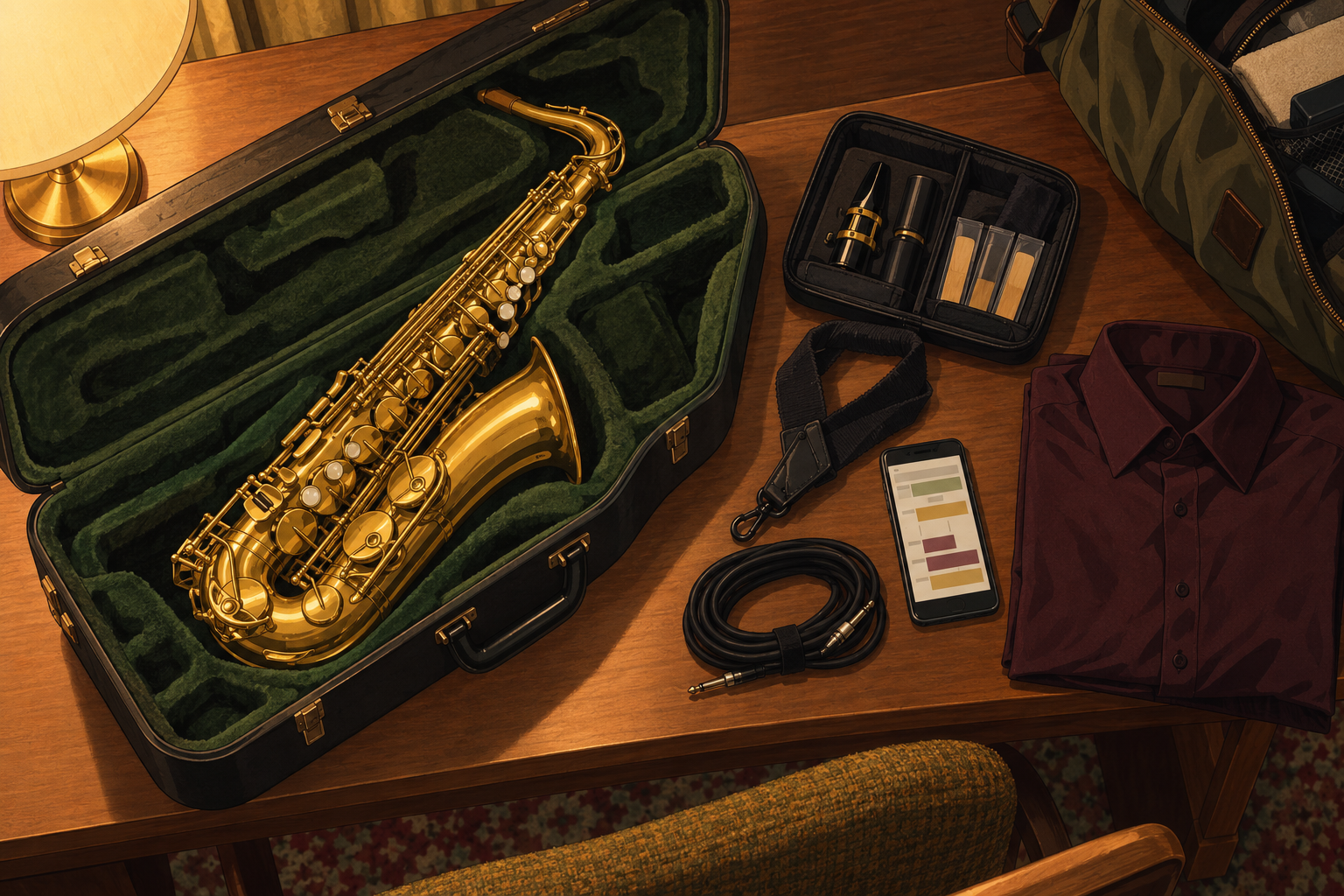
Build a small “I can still play” kit
This is one of the simplest ways to think about packing:
If my checked bag disappears for 24 hours, can I still walk into soundcheck and do the gig?
That question changes what you protect.
Within your allowed cabin space, keep the irreplaceable playing setup, essential adapters and cables, show files available offline, chargers, necessary medication, and if possible a compact change of performance clothes. For saxophone, I am thinking mouthpiece, reeds, ligature, neck strap — the stuff you do not want to be shopping for in a strange city two hours before downbeat.
Backline needs names, models, and all the boring little pieces
“Keyboard supplied” means almost nothing.
Which keyboard? Weighted action? Outputs? Stand? Sustain pedal? Bench?
Same thing with drums. Same thing with amps. Same thing with pretty much everything.
The big item gets everybody’s attention. The stupid little missing item is often what burns fifteen minutes at soundcheck.
A keyboard is there but no sustain pedal. The amp is there but not the cable you need. The drum kit exists, but half the hardware apparently entered witness protection.
That is why substitutions are fine when everybody knows about them beforehand. A substitution at 2:00 p.m. is a conversation. A surprise at soundcheck is a problem.
Ground transportation is not a footnote
Get the driver’s name, number, pickup location, and the plan if your flight is delayed.
And make sure the vehicle can hold the actual people and the actual gear. Four musicians do not equal four musicians plus four suitcases plus instruments plus whatever giant case the drummer showed up with.
Hotel details matter for the same reason. Confirm the reservation name, room allocation, who is paying, and when you can get in.
If you land at 10:30 in the morning and normal check-in is 3:00, congratulations: you may technically have a hotel and still have nowhere to go.
That is the kind of detail that sounds tiny in email and feels enormous when you are standing in a lobby holding luggage.
If you are hired for the date, do not arrive learning the show
Get the music before you travel.
Set list. Charts. Recordings. Arrangements. Endings. Rehearsal expectations.
Download it.
Airport Wi-Fi should not be part of your preparation strategy. Neither should soundcheck.
From a bandleader’s perspective, a musician who knows the material and communicates early when something goes wrong gives you options. If your flight changes, send the new flight number, the new arrival time, what gear you still have with you, and what call you may miss.
“Hey man, I think I’m gonna be late” is not useful information.
And the leader has responsibilities too. Give the band one current itinerary. Clear calls. Clear gear assignments. One version of the truth. If three people are texting three different pickup times, somebody built the problem before the plane even left.
Send one final confirmation everybody can actually use
Your final advance should be short enough to read on a phone while somebody is walking through an airport.
That is a good test.
An unanswered item is still unanswered. It does not become confirmed because it has been sitting in an email chain for six days looking important.
Final advance: confirm these items
- Show: date, venue address, artist entrance, local-time calls, stage time, and set length.
- People: day-of contact, production contact, driver, and travel-change decision-maker.
- Travel: flights, airports, checked items, instrument plan, and return pickup.
- Hotel: reservation, rooms, payment, and access before the show.
- Equipment: confirmed backline, approved substitutions, current stage plot, and input list.
- Band: music, rehearsal expectations, clothes, and individual gear responsibilities.
- Money: fee, payment timing, covered expenses, and unresolved approvals.
A few questions musicians ask about fly dates
How early should I arrive for a fly date?
Work backward from the first required venue call, not from whatever arrival time looks convenient on the airline app. Leave room for getting off the aircraft, bags, ground transportation, setup, and delays. If one missed connection kills the show, consider traveling the day before.
Does the promoter supply all the equipment?
Only the equipment you actually agree on and confirm. “We’ve got everything” is not a backline list.
Can I always carry my instrument onto the plane?
No. For covered U.S. carriers, safe stowage and available cabin space matter. Check the operating airline, case dimensions, aircraft constraints, boarding situation, and your fallback before travel.
Leave yourself enough room to actually play well
This is the part I care about most.
The audience never sees the advance email. They do not know the keyboard showed up late. They do not know your driver went to the wrong terminal. They do not know you spent twenty minutes negotiating over a case at the gate.
They hear the show.
All this boring logistical stuff has one purpose: protect the performance.
Once the travel and stage plan are handled, think about what survives the show too. If audience capture is part of your plan, have the signup link or QR code working before you get there. I cover that separately in how musicians turn live shows into an owned audience.
Before you say yes to the next fly date, run the whole trip in your head from your front door to the first note.
Anything that makes you say, “Hmm… I guess we’ll figure that out when we get there” is probably the exact thing you should figure out now.
About Jackiem Joyner: Jackiem is a saxophonist, producer, author, and active touring artist. These field notes come from looking at shows from both the musician’s and bandleader’s sides of the stage.
Travel sources and policy checks
Instrument-rule references checked October 6, 2026. Airline baggage allowances, boarding options, and aircraft arrangements can change; verify them with the operating carrier before booking.