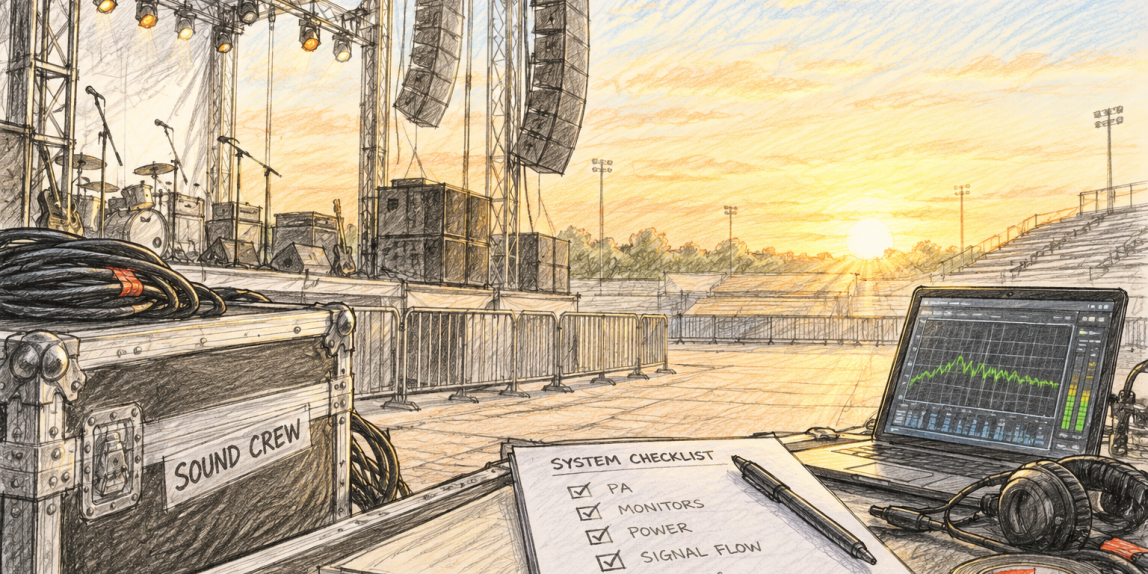
A good soundcheck is not a rehearsal with better speakers.
It is not the time to rediscover the arrangement, debate the ending, teach the drummer the bridge, or play the entire first set because somebody finally gave you a PA.
Soundcheck has a job.
Make sure the system works. Make sure the band can hear what it needs to hear. Make sure the front-of-house engineer has enough information to build the show. Fix the problems that actually need fixing.
Then get off the stage.
The fastest soundchecks usually come from bands that already know what they are trying to check.
Arrive with the production homework already done
If the crew is still trying to figure out where everybody stands, how many keyboard outputs exist, whether the playback rig is stereo, or why an unexpected amp just appeared, you are burning soundcheck time before anybody plays a note.
That is why a current stage plot and input list matters.
The paperwork is not glamorous. Neither is waiting twenty minutes while somebody searches for another DI box.
I will take boring preparation every time.
Start with line check, not a concert
Line check is exactly what it sounds like: confirm that the inputs are getting where they are supposed to go.
Kick. Snare. Toms. Bass. Keys. Guitar. Playback. Vocals. Horns. Whatever the show actually uses.
This is not the moment for everybody to play at once because silence feels awkward.
If the engineer asks for the kick, give them the kick.
Not kick plus bass plus a little keyboard pad because apparently restraint has left the building.
Line check
Does every source reach the console correctly? Are channels, DIs, mics and outputs working?
Soundcheck
Does the band balance correctly in the room and onstage? Are monitors usable? Do major show moments behave properly?
Give the engineer something representative
Once the inputs are working, I want to play material that tells the engineer something useful.
Not necessarily the song everybody loves most.
A representative song.
Something with normal drums, normal bass, keys, lead, vocals, playback if you use it, and the usual dynamic range of the show.
If the quietest song is acoustic and the loudest song sounds like the building is under attack, checking only one of those extremes will not tell us what the rest of the night is doing.
Do not chase a studio mix onstage
This is where musicians can lose the plot.
A live monitor mix is there to help you perform.
It does not have to sound like the record.
I need the things that keep me oriented: time, pitch, harmony, cues, lead information, whatever matters for that performance.
If I can play confidently, I am good.
If I spend ten minutes asking for the snare to feel “a little more expensive,” somebody should take the talkback mic away from me.
Simple rule: ask for changes that improve your ability to perform. Do not turn monitor world into a mixing seminar.
Make monitor requests one at a time
“More me, less keys, a little more drums, bass down, guitar up, maybe more vocal too” is how you make an engineer stare at the console and reconsider every life choice that led to this moment.
Give them one request, listen to the change, then make the next one. “Can I get a little more lead vocal?” Good. Hear it. Then: “Can I get slightly less guitar?” Good. That is faster, clearer, and easier for everybody.
Use the same language consistently
Stage left and stage right mean something. Use them. Calling somebody “the guy over there next to the keyboard but not that keyboard” is not production language.
If you are the bandleader, make sure the band knows who communicates with the crew and how.
Five musicians shouting five different monitor requests from five different directions is not collaboration.
It is weather.
Check the moments that can actually break the show
I do not need to play every song.
I do want to check the things that are technically unusual.
- Playback starts and stops correctly.
- Click goes only where it is supposed to go.
- Wireless systems are behaving.
- Instrument changes do not create surprises.
- The quiet section is actually quiet enough.
- The big section does not explode unexpectedly.
- Featured mics or guest positions work.
- Talkback and cue systems function.
If something has a realistic chance of wrecking the show, check it.
If it has been the same boring setup for six months and works every night, we probably do not need to hold a committee meeting about it.
Do not rehearse mistakes during soundcheck
This one matters.
If the band hits a musical mistake, fix it quickly if it affects the show.
But do not let one wrong chord turn soundcheck into forty minutes of rehearsal.
That is what rehearsal was for.
The venue crew did not sign up to watch the band learn the bridge.
If something truly needs work, make a note and solve it later.
Know when the room is lying to you
An empty venue does not sound like a full venue.
Hard surfaces are exposed. Seats are empty. Bodies are not absorbing anything. The room may feel brighter, longer or more aggressive than it will once people arrive.
That does not mean ignore what you hear.
It means do not panic because the room at 4:30 PM does not sound exactly like the room will at 8:00 PM.
The engineer knows the room better than you do.
Use that knowledge.
Protect the front-of-house engineer’s job
The engineer needs time to hear the band from the audience side.
If everybody is constantly stopping, talking, changing patches and playing random licks between instructions, they never get a clean picture.
Play when asked, stop when asked, and give them a full chorus or section long enough to actually hear the mix.
There is a surprisingly large amount of professionalism hiding inside the ability to stop playing.
Bandleaders: keep the stage moving
If you are leading the band, you are not just checking your own sound.
You are watching the clock.
Is somebody stuck?
Does production need an answer?
Is the drummer waiting because the keyboard player is still auditioning patches?
Did the set change but nobody tell the crew?
The bandleader’s job is to keep little problems from becoming the entire afternoon.
That is especially important on fly dates, festivals and compressed production days. I talk more about those realities in what musicians should know before taking a fly date.
Save your ears and your energy
Soundcheck is not the show.
You do not need to sing every high note at full power. You do not need to blow through the hardest passages like somebody is grading you. You do not need to play an extra forty minutes because it feels good in the room.
Check what needs checking, save something, and remember you still have a show to play.
Before you leave the stage, confirm the boring stuff
- Everybody can hear enough to perform.
- Playback and click are correct.
- Instrument changes are covered.
- Wireless systems are stable.
- Any problem channels have been resolved.
- Show-start positions are clear.
- The band knows the first song and first transition.
- Nothing important is being unplugged before showtime.
Then stop touching things. Seriously. There is a point where continuing to “improve” soundcheck just creates another opportunity to break something that was already working.
The goal is confidence, not perfection
A good soundcheck should leave the band feeling settled.
The system works. The important cues are there. The engineer understands the show. The musicians can hear enough to do their jobs.
That is success.
You are not trying to create the greatest sonic experience of the day while the room is empty and somebody is still taping cables to the floor.
You are trying to make the actual show easier to play.
Handle the technical problems. Communicate clearly. Get the band comfortable.
Then get the hell off the stage and save it for the audience.
About Jackiem Joyner: Jackiem Joyner is a touring recording artist, bandleader, producer and working musician. His live-performance writing focuses on the practical systems that make shows smoother before the audience ever hears the first note.