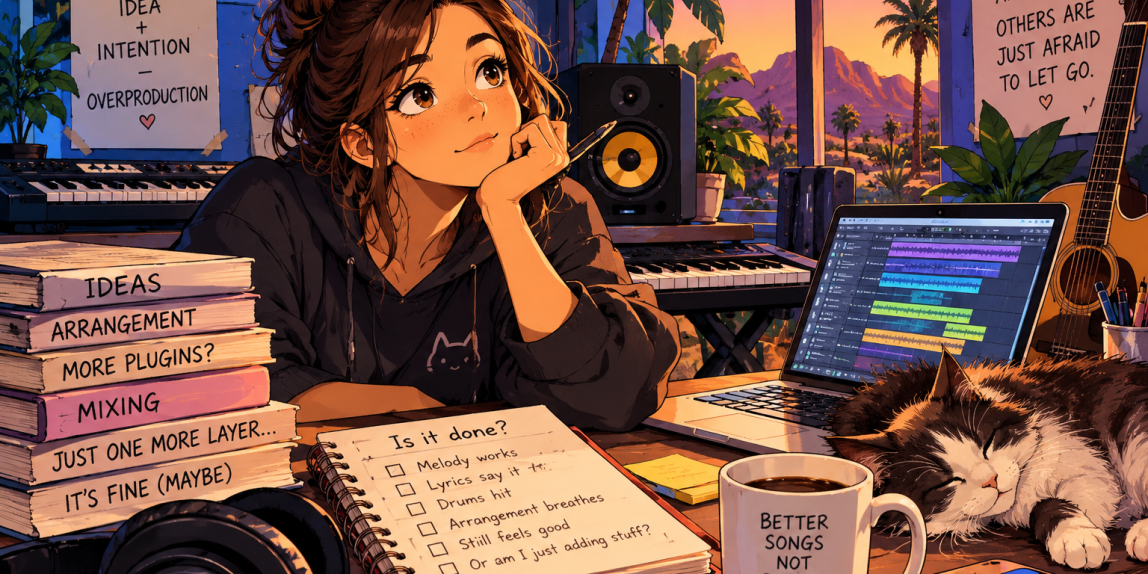
Overproducing a song usually does not happen because somebody woke up and said, “You know what this record needs? Forty-seven more things.” It happens one perfectly reasonable decision at a time.
You add a pad because the verse feels empty. Then a little percussion because the pad made the groove feel sleepy. Then another background part because the chorus needs lift. Then an effect because now the transition feels plain. Three hours later the song has acquired a small government.
I have produced enough music to know this trap because I have stepped in it myself. The dangerous part is that every individual addition can sound good by itself. The question is whether the record is getting better.
Overproduction is not “too many tracks.” It is when the production starts competing with the song it was supposed to serve.
First: this is different from asking whether the track is finished
I recently wrote about what producers listen for before calling a track finished. That question is about completion: performance, arrangement, translation, emotional center, and whether further revisions are actually helping.
This question is narrower.
Have I produced past the song?
A track can be unfinished and already overproduced. You can still have mix problems, a weak ending, or a vocal that needs work while simultaneously having six parts that need to disappear. So I do not use “finished” and “overproduced” as synonyms.
1. You keep adding because silence makes you nervous
Space can feel suspicious when you have been staring at a DAW for six hours.
There is an empty beat before the chorus. Surely something should happen there. There are only two instruments under the verse. Maybe we need a texture. The bridge gets quiet. Somebody call the synth department.
But empty space is not unfinished space.
Sometimes the hole is the arrangement doing its job. Space creates contrast. Contrast makes the next entrance feel larger. If every square inch of the record is decorated, nothing gets to arrive.
One test I use is simple: if I am adding something mainly because nothing is happening there, I want a better reason.
2. The hook has to fight for attention
The listener should not need a flashlight to find the reason the song exists.
If the vocal, melody, groove, sax line, guitar figure, or whatever carries the identity of the record is surrounded by equally assertive ideas, I have created competition.
This happens easily with good musicians because everybody can play something interesting. Interesting is not the same as necessary.
My test: mute three supporting parts. If the hook suddenly feels ten feet taller, those parts were not supporting it as much as I thought.
3. Every section is trying to be the big section
A record needs hierarchy.
If the verse is huge, the pre-chorus is huge, the chorus is huge, the bridge is huge, and the outro is huge, congratulations: nothing is huge anymore.
I want somewhere to go.
That may mean pulling the drums back. Dropping a keyboard. Saving a harmony. Letting the bass simplify. Holding the horn section until the second chorus. Production is not just choosing what happens. It is choosing when it gets to happen.
The parts you withhold can create as much excitement as the parts you add.
4. You are mixing around an arrangement problem
This one will eat an afternoon.
You cannot hear the lead, so you EQ the keyboard. Then the guitar feels dull, so you brighten it. Now the percussion is sharp. The vocal gets another compressor. The reverb changes. Everybody moves two inches and somehow nobody has any more room.
Sometimes the mix is not the problem.
Sometimes there are simply too many things trying to occupy the same musical job.
Before I reach for another plugin, I like to ask whether muting or simplifying one part solves the problem faster. If it does, I just saved myself from performing surgery on six tracks because one track would not leave the room.
5. The production sounds impressive, but the song feels smaller
This is probably the most important warning sign.
You can make a production wider, louder, cleaner, more detailed, more expensive-sounding — and somehow less moving.
That is when I stop being impressed by the session and ask what happened to the feeling.
Did the intimate verse become cinematic when it needed to stay close? Did the groove lose its pocket because everything got tightened to death? Did the lead performance lose vulnerability after too much correction? Did a simple melody get buried under cleverness?
I am not anti-technology. I use the tools. I love the tools. I just do not want the tools auditioning for the lead role.
6. You cannot remember why half the parts are there
Open an older session and solo a track you forgot existed. That can be educational.
Sometimes you hear it and think, “Oh yeah. That little thing is doing exactly what it needs to do.” Great.
Other times you think, “What in the hell was I doing?”
That second reaction is useful too.
Every part does not need to be obvious, but I should be able to identify its job: groove, harmony, hook, texture, transition, contrast, energy, support. “Because I spent two hours making it” is not a musical job description.
7. Version 18 is different from version 12, but not better
Revision can become its own form of procrastination.
You change the snare. Then you put the old snare back. You automate the pad. You remove the automation. You add a percussion loop. You mute it. You unmute it because apparently we are now emotionally attached to the percussion loop.
At some point, movement is not progress.
I like comparing a current version against an earlier bounce without looking at the session. Which one communicates faster? Which one makes the chorus land? Which one makes me feel something?
If the older version keeps winning, I pay attention.
8. The mute button improves the record more than the plugin does
This may be my favorite production tool because it costs nothing.
Mute the extra guitar. Mute the second pad. Mute the doubled percussion. Mute the background line you are weirdly proud of.
Then listen to the whole record, not the missing part.
Does the groove breathe? Does the lead come forward? Does the chorus feel cleaner? Does the emotional idea become easier to understand?
If yes, believe what you are hearing.
Producers sometimes defend a part because the part sounds great. Nobody said it did not. A beautiful part can still be wrong for the record.
My subtraction pass
When I suspect I have gone too far, I make a pass where I am not allowed to add anything. I can only:
- mute
- simplify
- shorten
- lower
- move an entrance later
- remove an effect
- restore dynamics
That restriction changes the question from “What else can I do?” to “What is this song actually asking me to keep?”
I also listen away from the screen. The DAW is excellent at making every tiny thing look important. Listeners do not get colored waveforms and 94 track names. They get the song.
The goal is not minimalism. The goal is intention.
I am not saying every production should be sparse. Some records should be enormous. Stack the vocals. Bring in the strings. Add the percussion. Let the synths cover the horizon.
But if the record is dense, I want the density to be a decision — not evidence that nobody knew when to stop.
That is the distinction.
A simple record can be overproduced. A massive record can be beautifully disciplined.
For me, the warning light comes on when the production starts requiring explanations for why the song no longer hits the way it did before all the “improvements.”
If muting a few things makes the melody clearer, the groove deeper, the emotion stronger, and your shoulders drop because the record can finally breathe again, there is your answer.
You probably did not need another idea. You needed permission to take one away.
Related: What Producers Listen For Before Calling a Track Finished · How to Arrange a Song So Every Section Has a Job