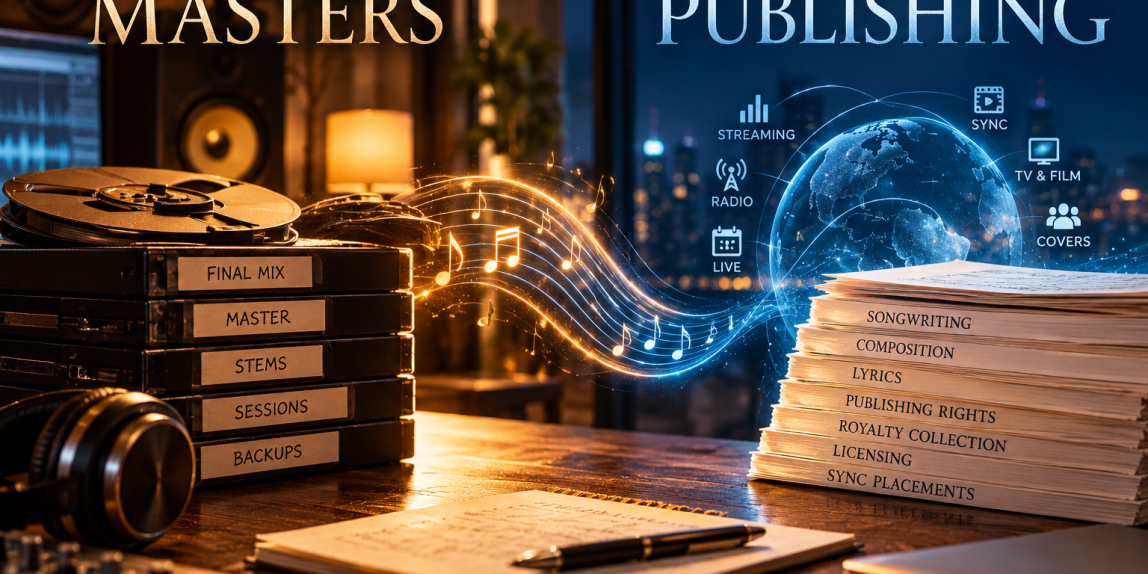
When somebody says, “I own my music,” my first question is: which part?
Because one song can contain two different copyrights that people casually talk about as if they are the same thing. They are not.
There is the musical work—the composition itself, meaning the melody, harmony, rhythm and lyrics if there are lyrics. Then there is the sound recording—the particular recorded performance you actually hear.
The U.S. Copyright Office treats those as separate works. That distinction is the cleanest place to start if you are an independent artist trying to understand masters, publishing and where your money can actually come from.
The master is the recording. Publishing lives on the composition side. You can control one, both, or neither.
Think of the song and the recording as two layers
The composition
The underlying song: melody, harmony, rhythm and lyrics. Songwriters and composers create this side. Publishing interests attach here.
The sound recording
The specific recorded performance of that composition. A label, artist, company or another rights owner may own or control this side depending on the deal.
This gets easier when you stop thinking of a released track as one object.
Imagine I write an instrumental composition today. That composition exists as a musical work. Tomorrow I go into the studio, produce it, perform it and create a finished recording. Now there is also a sound recording.
Same piece of music. Two rights layers.
And this is why saying “I wrote it” does not automatically answer who owns the master. It also works the other way: owning a master does not automatically mean you wrote or own the underlying composition.
What does “owning your masters” actually mean?
In plain English, it means owning the copyright in the sound recording—or having the ownership and control defined by your agreement.
That matters because the master is the asset being exploited when that particular recording is streamed, licensed, sold, used in certain broadcasts or placed in visual media.
But here is where artists get themselves into trouble: do not determine ownership from vibes.
You paid for the session? Good fact. You produced it? Important fact. Your name is on the front cover? Also a fact.
None of those facts, standing alone, is a substitute for reading the agreement and knowing how the recording was created and financed.
Working-artist rule: before you build a business plan around “my masters,” pull the actual contracts, split information and catalog records. Memory is not chain of title.
Publishing is not the master
Publishing sits on the composition side.
If you wrote 100% of a song and did not transfer that interest, you may control the writer and publishing interests associated with the composition. If you co-wrote it, there may be multiple writers and publishers. If you signed a publishing or administration agreement, another company may administer some of those rights even when you retain ownership.
That last distinction matters too: ownership and administration are not always the same thing.
An administrator may have authority to register works, issue certain licenses and collect income without becoming the permanent owner of the copyright. A publishing deal can be structured differently. Read the actual grant of rights.
One release can put you in several different seats
Independent artists often wear so many hats that the rights become easy to blur.
On one track, you might be the songwriter or composer, publisher, featured recording artist, producer, sound-recording owner and the person whose company released the master.
Those are not six fancy ways to describe the same job. They can create different rights, contractual interests and payment paths.
That is why I want independent artists to stop asking only, “How many streams did I get?” and start asking, “What rights do I actually control, and are all of them registered correctly?”
Different royalty systems are another clue that the rights are different
Look at how the U.S. music business actually pays people.
SoundExchange collects statutory digital performance royalties for certain non-interactive digital uses of sound recordings and distributes them to featured artists and sound-recording rights owners. SoundExchange explicitly says it does not collect songwriter or publisher royalties.
On the composition side, The Mechanical Licensing Collective handles U.S. blanket mechanical royalties from eligible digital audio streaming and download activity and works to match recordings to registered musical works so songwriters and publishers can be paid.
Then there are performing-rights organizations handling performance income on the composition side, plus direct licenses, distributors, labels, publishers and administrators depending on the use and deal.
That is the point: there is no single magical “music royalty.” Money follows rights, uses, registrations and contracts.
Owning both sides can be powerful—but do not romanticize it
I understand why “own your masters” has become almost a slogan.
Ownership can absolutely be valuable. If you own the recording and the composition, you may have more control over licensing, dealmaking and long-term catalog economics.
But ownership also means responsibility.
You have to know what you own. You have to register things properly. Metadata has to be right. Splits need to be documented. Licenses have to be tracked. Statements have to be reviewed. Agreements have to be stored somewhere you can actually find them.
I have dealt with music income long enough to know that a right you cannot document, locate or administer cleanly can turn into a very expensive piece of confusion.
That is one reason I keep coming back to metadata. If you want the deeper operational side, read Music Metadata Isn’t Just for Spotify Anymore.
A simple example: you write it, record it, release it
Say you write a new instrumental by yourself.
You fund the recording yourself. There is no label acquiring the master. You hire musicians under clear agreements, finish the record and release it through your own company.
Potentially, you may control both major layers: the composition you wrote and the finished sound recording you own.
Now change one fact. You wrote the composition, but a label funded the recording and your recording agreement gives the label ownership of the master. You may still have composition rights while the label owns the recording.
Change another fact. You own the master, but three people co-wrote the song. Now the recording ownership and composition splits tell two different stories.
This is why I keep saying: separate the layers.
What should an independent artist actually document?
- song title and alternate titles;
- writers and agreed composition splits;
- publisher or administrator information;
- sound-recording owner;
- featured artist credits;
- producer and other contractual royalty participants;
- ISRC for the recording;
- relevant work identifiers and registrations;
- release and distributor information;
- licenses, label agreements, producer agreements and split sheets;
- where the controlling documents actually live.
You do not need to become a copyright lawyer to run a clean catalog. You do need to stop treating rights information like trivia you will remember later.
“I paid for it, so I own everything.”
Maybe. Maybe not. Payment is part of the factual story; contracts and copyright rules still matter.
“I wrote the song, so I own the master.”
Writing establishes your relationship to the composition. It does not automatically settle ownership of a particular recording.
“My distributor has the master.”
A distributor can deliver and monetize a recording without necessarily owning the copyright. Read the distribution agreement instead of assuming what the relationship means.
“The platform will figure it out.”
Please do not build your retirement plan around that sentence. Registration and metadata exist because systems need accurate information to connect uses to the right people.
Before your next release, ask these five questions
- Who owns the composition?
- Who owns the master?
- Who administers each side?
- Who is contractually entitled to participate in the income?
- Have the rights and metadata been registered in the places that matter?
If you cannot answer those questions, that is the work.
Not another social post.
Not another playlist pitch.
The paperwork.
The bigger lesson is control with clarity
I am pro-ownership. I am also pro-understanding what the hell you own.
The phrase “own your masters” is useful because it got artists thinking about assets instead of only attention. But the mature version of that conversation is bigger.
Know the master. Know the composition. Know the contracts. Know the registrations. Know who participates in each stream of income.
Then when an opportunity arrives—a license, a catalog conversation, a new distributor, a label offer, a sync inquiry—you are not starting with, “I think I own that.” You know.
About Jackiem Joyner: Jackiem Joyner is a recording artist, composer, producer, touring musician and music-business operator whose career has included both independent releases and label relationships. His writing focuses on the practical systems working artists need to understand behind the music.