
A music-release budget is not a contest to see how professionally you can spend money. The job is to get the record finished, presented well, and in front of the right people without waking up afterward wondering why your bank account looks like a crime scene.
Independent artists get into trouble because a release has a hundred things you could spend money on. Recording. Mixing. Mastering. artwork. photos. video. ads. radio. PR. playlist pitching. merch. content. vinyl. travel. software. Somebody always has one more service that is supposedly the missing piece.
The answer is not “spend nothing.” Cheap can be expensive too.
The answer is knowing what job each dollar is supposed to do.
If you cannot explain what a line item is supposed to change, it does not automatically deserve money just because somebody sells it.
Start with the number you can actually survive
I do not like building a fantasy release and then asking, “Okay, how do I pay for all this?” Start from the other direction.
What amount can you put into this release without screwing up rent, payroll, touring, your next project, or the rest of your life?
That is your real ceiling.
A release budget should create pressure to make decisions. It should not create panic.
And remember: the cost of a release is not only the obvious invoice. If you spend three weeks making content, miss paid work, or buy equipment you did not need, that is part of the economic picture too.
Protect the music first
If the recording is weak, a bigger marketing budget just helps more people hear the weakness.
So my first priority is the actual product: whatever it takes to get the performance, production, mix, and master to the standard the record deserves.
That does not mean every release needs the most expensive studio, mixer, or mastering engineer you can find. It means do not starve the thing people are ultimately supposed to care about.
I would rather have one properly finished song and a sensible rollout than five half-finished songs surrounded by gorgeous graphics.
Must work
The record itself: writing, production, recording, editing, mix, master, and any essential musicians or studio needs.
Must communicate
The basic assets that help people understand and encounter the release: artwork, distribution setup, clean metadata, and a workable release page.
Can create leverage
Promotion that has a defined audience and purpose: email, content, paid media, PR, radio, creator collaborations, or other channels that fit the release.
Nice if justified
Extras that may be cool but are not automatically necessary: elaborate merchandise, expensive video concepts, specialty formats, or one-off vanity purchases.
Separate production money from promotion money
This sounds obvious until the mix takes longer than expected and suddenly the money that was supposed to introduce the record to the world has disappeared into revision number seventeen.
I like knowing the buckets before the spending starts.
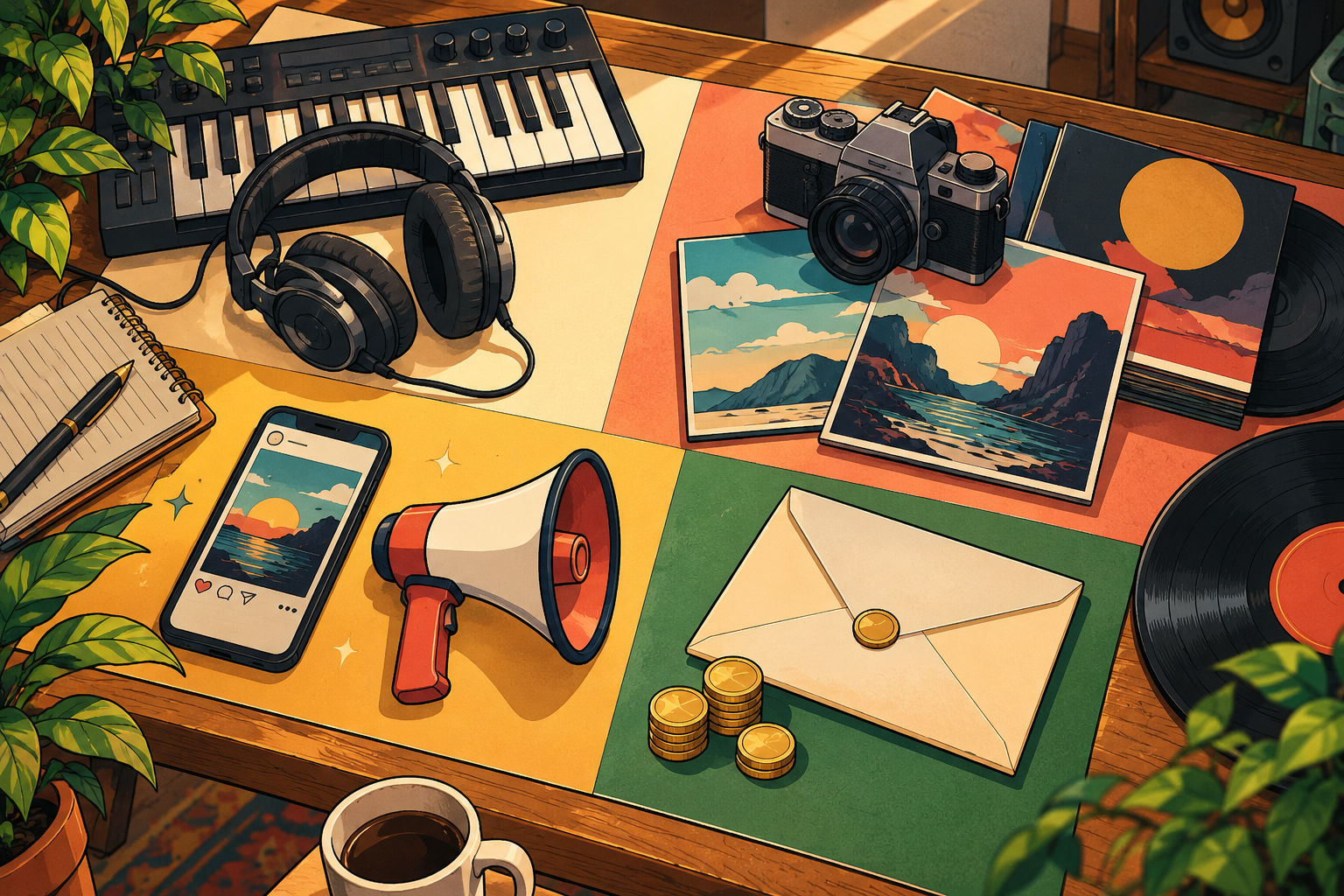
Music-production money gets the record finished. Release money gets it packaged and delivered. Promotion money helps people discover it. Reserve money handles the stupid surprise that apparently attends every creative project ever made.
If one bucket starts eating another, make that decision consciously.
Do not buy marketing because you are nervous
This is where artists can light money on fire.
The release date gets close. Streams are uncertain. Everybody online seems to be selling something. Now suddenly a $1,500 package feels “necessary” because at least it feels like you are doing something.
Activity is not the same as leverage.
Ask who the service reaches, what the deliverable actually is, what happens after the campaign, and how you will know whether it helped.
If the answer is mostly adjectives—“exposure,” “buzz,” “visibility,” “industry attention”—keep your hand on your wallet until the nouns and numbers show up.
Spend where the asset keeps working
I pay more attention to things that leave something behind.
A good website page keeps working. Email and SMS contacts keep working. A strong piece of video can keep working. Useful photographs keep working. Good metadata keeps working. A direct fan relationship keeps working.
That is one reason I care so much about owned audience. I wrote about turning live shows into an owned audience because the value does not end when one campaign ends.
An expense that creates an asset is different from an expense that creates 48 hours of activity and then vanishes.
Do not budget every release like it is the Super Bowl
Not every song needs the same level of spend.
Some releases are important catalog builders. Some are tests. Some are part of a larger album cycle. Some have obvious single potential. Some exist because they belong in the world and you want to keep moving.
The budget should match the job.
If every release becomes a giant event, eventually you become financially afraid to release music. That is a terrible system for an artist.
A useful question: If this release performs only modestly, will I still be glad I spent this amount because I created a good record, useful assets, audience data, and catalog value? If the answer is no, the budget may be carrying too much hope.
Leave some money uncommitted
I do not love a release budget that is spent down to the last dollar before the song even comes out.
You may discover that one piece of content is working. You may get a real press opportunity. A city may respond. A collaboration may open. You may need another edit, another piece of art, a rush delivery, or a second round of something that is actually producing results.
Keep some flexibility.
You want the ability to respond to evidence instead of having to say, “Damn, we spent everything three weeks ago.”
Measure the release like an investor in your own catalog
I am not saying every release has to pay itself back immediately. Music does not always work that neatly.
But after the release, I want to know what happened.
- What actually drove traffic?
- What created email or SMS signups?
- What generated sales?
- What content got real engagement?
- What city or audience segment responded?
- Which expense would I happily buy again?
- Which one sounded great in the pitch and did basically nothing?
The next budget should know what the last budget learned.
Your artist career gets expensive when every release starts from zero.
The goal is not to spend less. It is to waste less.
Sometimes the right decision is to spend real money.
Hire the musician. Hire the mixer. Make the strong visual. Put money behind something that is clearly working. Pay for expertise you genuinely do not have.
But make the dollar audition for the song.
If you know what the release is trying to accomplish, what assets matter, what audience you are trying to reach, and what you can afford to lose without wrecking the next move, the budget becomes a tool.
Otherwise it becomes a receipt collection with a release date attached.
And nobody needs that.
About Jackiem Joyner: Jackiem Joyner is a recording artist, producer, songwriter, author and working music-business operator. He writes about the practical decisions behind building a music career that can survive beyond one release cycle.